Mobility EngineeringMobility Engineering


Driver Test Station

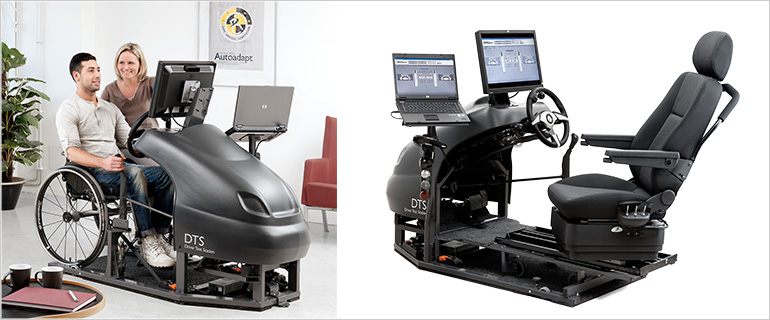
Driver Testing StationThe Purpose of the Driver Test Station

By measuring the driver’s ability to apply force, move the limbs and to react quickly, you will have a considerably improved and more comprehensive base of knowledge when planning for a car adaptation.

If some of the measured values are low, this doesn’t necessarily mean the individual is unfit as a driver. The ability to drive is always a matter of finding other ways to do the same thing.

What is the DTS?

The DTS is not a simulator or a ”Playstation”. The DTS is designed as a tool to help the therapist, or the person making the prescription, to perform a qualified test of a person’s abilities as a driver, concerning strength, flexibility, behaviour and reaction time.

By using the DTS you can evaluate the ability of the driver, founded on facts, and the person being tested can feel reassured that the tests are objectively conducted.

  • The DTS is delivered with software and user instructions.
  • The computer and the screen are not included.
  • The software of the DTS is easy to use, pedagogically visualised and provides possibility for individual settings.
  • The DTS also gives you the ability to simulate a specific car model.

1. Strength

With the DTS test station you are able to measure how much strength the driver has to:

  • Press down the brake pedal using the right or the left foot.
  • Use a hand operated accelerator and brake, pushing forward to brake and pulling backwards to accelerate. Both the right hand and the left hand can be tested.
  • Turn the steering wheel to the right and to the left (measured at different inertia settings)

2. Timer Test

The Timer Test is designed to motivate the driver to try his/her best during the test. The test gives the therapist a good opportunity to study how well the driver manages to coordinate his/her movements and also to see how flexible the driver is in combination with the ability to grip a handle or to switch from one pedal to another.

This test is a very good tool for making a fair judgement of the total ability.

Testing a driver's ability to steer3. Reaction Time

With the DTS you can also measure reaction time, using either the legs or the hands. There are two different types of tests available to show how quickly the driver can react, after a few practice runs.

  • Emergency brake test: reacting on a traffic light signal.
  • 6 - point reaction test: using a random handle or pedal when signaled on the screen.

The Ability to Steer

The DTS has a feature for adjusting the steering wheel inertia (measured in Kg, Lbs or Newton). Start the test by having a slack setting and proceed by tightening the steering wheel until the driver begins to have difficulties turning it one entire round.

When having slight difficulties turning the steering wheel, a prescription for adjusting the steering wheel servo-unit of the vehicle can be advised. Maybe it’s enough just to choose a vehicle model with a progressive servo feature.

If the driver is too weak to manage a steering wheel at all, it’s a case for considering a joy-stick or a mini steering wheel.

Knobs to assist the driverChoose the right Steering Knob

When a driver uses one hand to steer the vehicle and the other hand to manage the accelerator and brake, it is so much easier to steer with the help of a steering knob.

With the DTS you can take your time choosing among the variety of knobs and steering devices. If the driver is unable to hold on to a knob it might help to try a 2- or a 3-pin steering device, which supports the hand.

Testing the Drivers arms and handsThe Arms / Hands

If the driver is unable to use the pedals you can test if the arms have enough strength to fully brake when using a hand operated accelerator and brake control.

The DTS has a floor mounted control and a steering wheel mounted control. The controls are mounted on each side of the steering wheel, so that both hands can be tested.

Testing the drivers legs and feetThe Legs / Feet

The Strength Test using the pedals, in combination with the Timer Test will provide a good picture of the driver’s ability to brake, as well as how quickly he/she can manage to move from one pedal to another.

Slight disabilities, such as reduced mobility of the right leg might be compensated by installing a left hand side pedal for the accelerator, whereas severer mobility reductions would require a hand operated control for acceleration and brake.

Test ReportThe Test Report

The DTS software produces a PDF test report for each tested individual.

The test report can be used as a matrix for a car adaptation, since all the necessary values are at hand for creating the best possible driver environment.

It can sometimes be difficult to decide if the individual is fit enough as a driver. The DTS test report is not only a support for the decision itself, but also a help when informing an individual about a negative outcome.

Located at: 4/45 Salisbury Road, Asquith NSW 2077. Phone: 02 9482 4572

Contact Us - Homepage of Mobility Engineering

Search Engine Optimisation Brisbane by: Going Rank Australia